
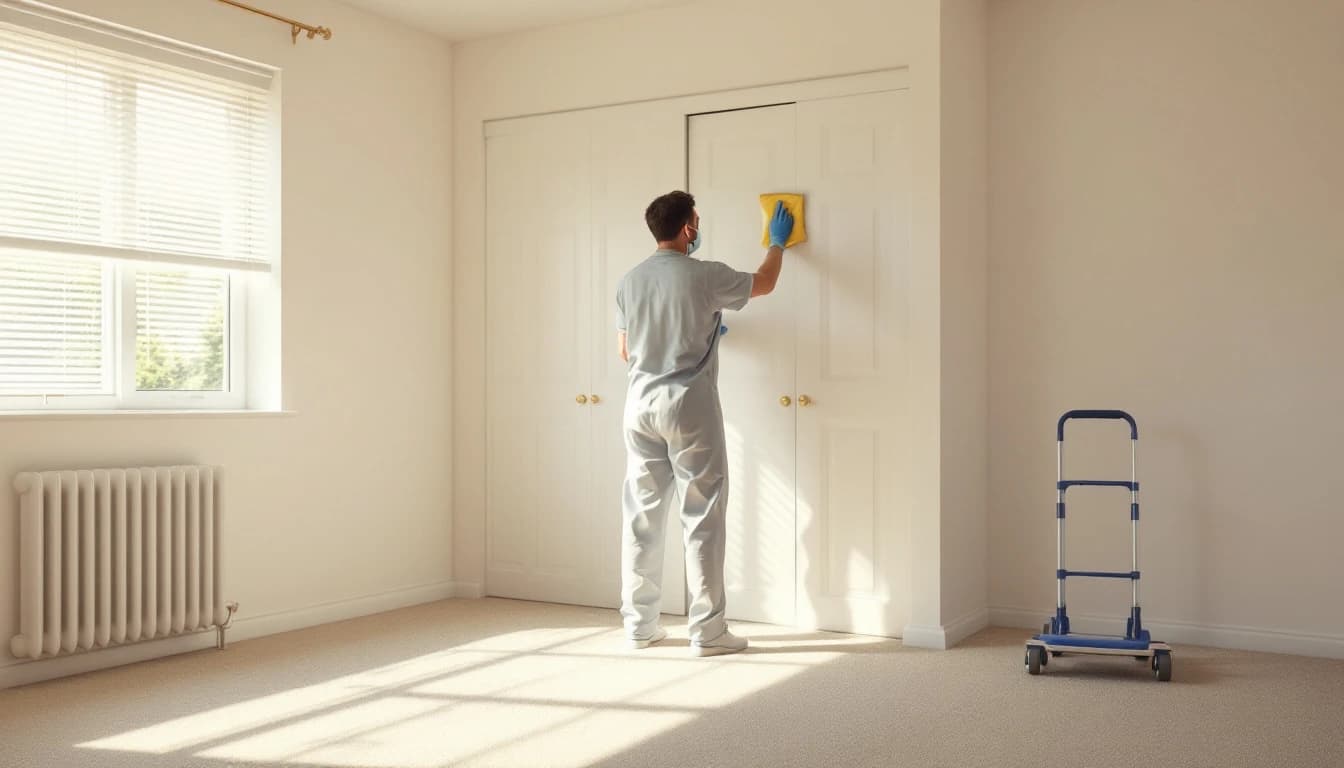
2026 Benbrook, TX move-out cleaning guide: $200-$500 flat rate, what broom clean and professionally cleaned really oblige you to do, plus garages and pollen
Most disputes about move-out cleaning are not really arguments about dirt. They are arguments about a phrase — three or four words buried in a lease that the tenant and the landlord read completely differently. "Broom clean." "Professionally cleaned." "Same condition as received." Each of those sets a genuinely different bar, and the gap between what a renter assumes it means and what a property manager enforces is where security deposits go to die.
Benbrook makes that gap unusually visible, because it is a mixed-tenure suburb. Drive the streets off Winscott and around the lake and you find solid brick homes from the 1970s through the 1990s on generous lots with mature trees, occupied by long-time owners who have been there twenty years — next door to the same house being rented out by an owner who moved and kept it. Two identical floor plans, two completely different standards at move-out, because one is being handed to a landlord and the other is being handed to a buyer.
As of August 2026, move-in/move-out cleaning runs $200 to $500 as a flat rate, quoted before any work starts. This guide starts with the lease language, then covers what the local housing stock and climate actually do to a house, and finishes with how the seller's version of the job differs.
Reading the Cleaning Clause Before You Argue About It
Pull out your lease and find the move-out or surrender section. Whatever it says is the standard you will be measured against, and it is worth ten minutes now rather than a phone call later. The phrases below are the ones that show up most often, and the difference between them is not cosmetic.
| Lease phrase | What it customarily requires | What it does not cover | Where tenants get caught |
|---|---|---|---|
| Broom clean | Remove all belongings and debris; sweep floors | Any surface, appliance, or fixture cleaning | Assuming it means the unit can be handed over as-is once emptied |
| Clean and free of debris | Broom clean plus visibly clean surfaces | Detail work like tracks, grout, or appliance interiors | Wiping counters but skipping the oven and refrigerator |
| Professionally cleaned | A full vacant clean at a service standard | Repairs, paint, carpet replacement | Doing it yourself when the clause implies a paid service |
| Same condition as received, wear excepted | Match the documented move-in condition | Ordinary wear and tear over the tenancy | Having no move-in photos to define what received meant |
| Carpets professionally cleaned | A separate carpet service on top of the clean | The rest of the home | Booking the house clean and forgetting the carpet line |
A few notes that apply across all of them.
Normal wear and tear is yours to keep. Texas state law allows a landlord to deduct for damage and for cleaning beyond normal wear and tear — not for ordinary wear itself. Faded paint, minor carpet traffic wear, and small nail holes from hanging pictures generally read as wear. A greasy oven, a mildewed shower, and grimy blinds read as cleaning. Knowing which side of the line an item falls on is most of the argument.
"Same condition as received" is only as strong as your evidence. If you never photographed the place on move-in day, the phrase quietly becomes "same condition as the landlord remembers." Photos at both ends turn a subjective standard into a documented one.
A clause can be more demanding than the state's floor. Your lease can ask for more than a bare legal minimum, and if you signed it, that is the bar. Read what you agreed to rather than what you think is customary.
Broom Clean Is a Debris Standard, Not a Cleaning Standard
This deserves its own section because it causes more Benbrook deposit deductions than anything else on the list.
"Broom clean" originates as a construction and commercial term. It means the space is emptied and swept — no boxes, no trash, no leftover furniture, no sawdust. It says nothing at all about the inside of the oven, the shower grout, the window tracks, the ceiling fans, the baseboards, or the refrigerator gasket. A unit can be perfectly broom clean and still generate a substantial cleaning deduction, because the landlord is not deducting against the broom-clean clause; they are deducting under the general provision that lets them charge for cleaning beyond normal wear and tear.
The practical translation: broom clean is the floor of what you owe, not the ceiling of what you will be charged for. If your lease says broom clean and nothing more, you should still expect the appliance interiors, the bathrooms, and the trim to be inspected — because they will be.
What Benbrook Houses Do When They Empty Out
The building stock here is the second half of the story. These are mostly solid, conventionally built brick homes from a thirty-year stretch of construction, on lots with real trees, in a part of southwest Fort Worth shaped by Benbrook Lake and the Clear Fork. That combination produces a specific set of conditions.
Mature trees mean a genuine dust and pollen load. The tree canopy that makes these neighborhoods pleasant also drops pollen, seed, and leaf debris for most of the year, and North Texas adds cedar and ragweed seasons on top. That material collects in window tracks, on sills, along the tops of door frames, in patio door channels, and on horizontal blind slats. It is invisible while you live there and obvious in an empty room with the light coming in.
Lake-adjacent humidity shows up in bathrooms. Homes closer to the water and the wooded areas around the lake tend to hold humidity a little longer, and older bathrooms with original exhaust fans do not always clear it. The result is soap film and mildew shadowing at grout lines, along tub-to-tile joints, and around window frames in the bath. This is one of the few items where a landlord's "cleaning" charge and a "damage" charge start to blur, so it is worth addressing properly rather than wiping the surface.
Hard water leaves scale on everything it touches. North Texas water is hard, and it leaves mineral haze on shower glass, chrome fixtures, faucet bases, and the inside of toilet bowls. Ordinary wiping does not remove it — it needs descaling. Hard-water scale on a master shower is one of the single most-cited items at any Tarrant County walkthrough.
Original cabinetry, emptied, tells on itself. Kitchens in these homes often have their original or first-replacement cabinets. Once the drawers and shelves come out, you get liner adhesive residue, decades of crumbs in corners, and dust on the underside of the upper cabinets. Cabinet and drawer interiors are standard inspection items and they are almost never touched during a tenancy.
Painted trim carries the whole history of the house. Baseboards, door casings, and door faces show every scuff, and in a home with mature landscaping just outside, they also carry a film of fine dust. Trim is what separates a tidied house from a cleaned one, and inspectors know exactly where to look.
For the room-by-room version of this in checklist form, our Haltom City move-out guide covers a comparable older-stock market, and the deep cleaning service page explains where detail work sits relative to a standard visit.
The Garage, the Workshop, and Everything Behind Them
Benbrook garages are not decorative. Two-car attached garages on these homes have generally spent thirty or forty years as workshops, storage, second refrigerator locations, and lawn equipment sheds — and both leases and buyers count them as part of the property.
What emerges when one is finally emptied is predictable: dust on every horizontal surface, cobwebs in every corner and along the door track, oil or paint staining on the slab, sawdust or grass clippings in the corners, and a wall of pegboard or shelving that has not been wiped since it went up. Sellers in particular underestimate this, because buyers absolutely walk through the garage and it is often the last impression before they leave.
Two adjacent spaces get skipped for the same reason: the utility or laundry area, including the floor and wall behind where the washer and dryer stood, and any storage building or covered patio storage in the back yard. Both are part of the premises. Both are quick if they are on the list and awkward if they are discovered on inspection day.
Selling Instead of Renting: The Standard Moves
If you are the owner rather than the tenant, there is no deposit at risk, but the audience is tougher in a different way. The people judging the house are a buyer forming an impression during a final walkthrough and an agent making notes, and they are comparing your empty house against other empty houses they saw that week — several of which may have been cleaned specifically for the listing.
The task list barely changes. What changes is the priority order. On a rental walkthrough, the landlord's eye goes to the deduction list: appliances, bathrooms, trim, blinds. On a sale, the buyer's eye goes to the things that read as maintenance: the condition of the windows and glass, whether the cabinet interiors are clean when they open one, whether the garage looks cared for, and whether the bathrooms look like someone kept up with them. A greasy range hood does not cost a seller a deduction, but it does quietly cost credibility during a price conversation.
The other difference is timing. A renter cleans once, after the truck and before the key handover. A seller may want the vacant clean before the final walkthrough and, if the house has been sitting empty for weeks, a light refresh right before closing. Empty houses do not stay clean indefinitely — they collect dust exactly the way an occupied one does, without anyone there to notice.
Timing and What the Flat Rate Covers
Whichever side you are on, the sequence is the same: truck out, then clean, then walkthrough. Cleaning before the move is money spent on a house that is about to be scuffed by dollies, propped doors, foot traffic, and packing dust. An empty home also cleans genuinely better — the crew reaches the floor under where the bed stood, the wall behind the dresser, the closet floors, and the baseboard run that has been behind a bookcase for a decade.
Leave the utilities on. Water, hot water, and electricity all need to be live. Schedule any disconnect for after the cleaning and after the inspection, and confirm whether trash bins are still on site so there is somewhere to put debris.
Move-in/move-out cleaning at $200 to $500 is a vacant whole-home clean: oven and refrigerator interiors, cabinet and drawer interiors, baseboards and door frames throughout, window tracks and sills, blinds, light fixtures and ceiling fans, full bathroom detail including hard-water descaling, closet interiors, laundry area, and floors corner to corner. For comparison, a standard house cleaning runs $120 to $250 in a furnished, maintained home, and a deep clean runs $200 to $450 for detail work in a house someone still lives in. If you are weighing a one-time job against an ongoing schedule at your new address, our guide to recurring versus one-time cleaning breaks down the difference.
Where a Benbrook home lands inside $200-$500 depends on bedroom and bathroom count, whether the garage is included, appliance count, the amount of glass and trim, and the condition it is left in. We quote one flat number before we begin. There is no hourly meter and no "call for pricing" evasion — you get a real figure from a short conversation about the house. Every cleaner is background-checked, and we are insured and bonded.
To book, call (682) 201-2909 or email info@lauramaidservices.com with your move date, the bedroom and bathroom count, whether the home will be empty, and what your lease clause says if you are renting. We have served Benbrook and southwest Tarrant County since 2003. Start from the Benbrook cleaning hub, the Benbrook move-in/out page, the move-in/move-out service page, or our Benbrook house cleaning cost guide. Moving a little further south? We cover Crowley as well.
Frequently Asked Questions
Does broom clean in my lease mean I do not have to clean the unit?
No. Broom clean means emptied and swept, and it says nothing about appliance interiors, bathrooms, trim, blinds, or window tracks. Landlords can still deduct for cleaning beyond normal wear and tear under the general provisions of the lease and Texas state law, so treat broom clean as the minimum you owe rather than the maximum you can be charged for.
If my lease says professionally cleaned, can I do it myself?
Read the exact wording, because it varies. A clause requiring professional cleaning generally implies a paid service and sometimes a receipt, and some landlords ask for one at the walkthrough. If you are unsure, ask the property manager in writing before move-out day — a two-line email now is cheaper than a disputed deduction later.
How much does move-out cleaning cost in Benbrook, TX?
Move-in/move-out cleaning runs $200 to $500 as a flat rate quoted before work begins. A typical three-bedroom, two-bath Benbrook brick home sits in the middle of that range. Adding the garage, extra bathrooms, a large amount of glass and trim, or heavy hard-water buildup moves it upward.
Should the garage be part of the move-out clean?
Yes, for both renters and sellers. Garages here have usually served as workshops and storage for decades, and they collect dust, cobwebs, staining, and debris that is only visible once they are emptied. Buyers walk through the garage during a final walkthrough, and landlords count it as part of the premises even when tenants mentally do not.
Is the cleaning different if I am selling rather than renting out?
The task list is nearly the same; the priority order changes. Renters are judged against a deduction checklist heavy on appliances, bathrooms, and trim. Sellers are judged on the overall impression - glass, cabinet interiors, the garage, and whether the bathrooms look maintained - because the buyer is forming a view of how the house was cared for.
Do I need a separate carpet cleaning service?
Sometimes. Many leases carry a distinct carpet clause requiring carpets to be professionally cleaned at move-out, which is a separate service from the house clean itself. Check whether your lease lists it separately, because booking only the house clean and overlooking the carpet line is a common and entirely avoidable deduction.