
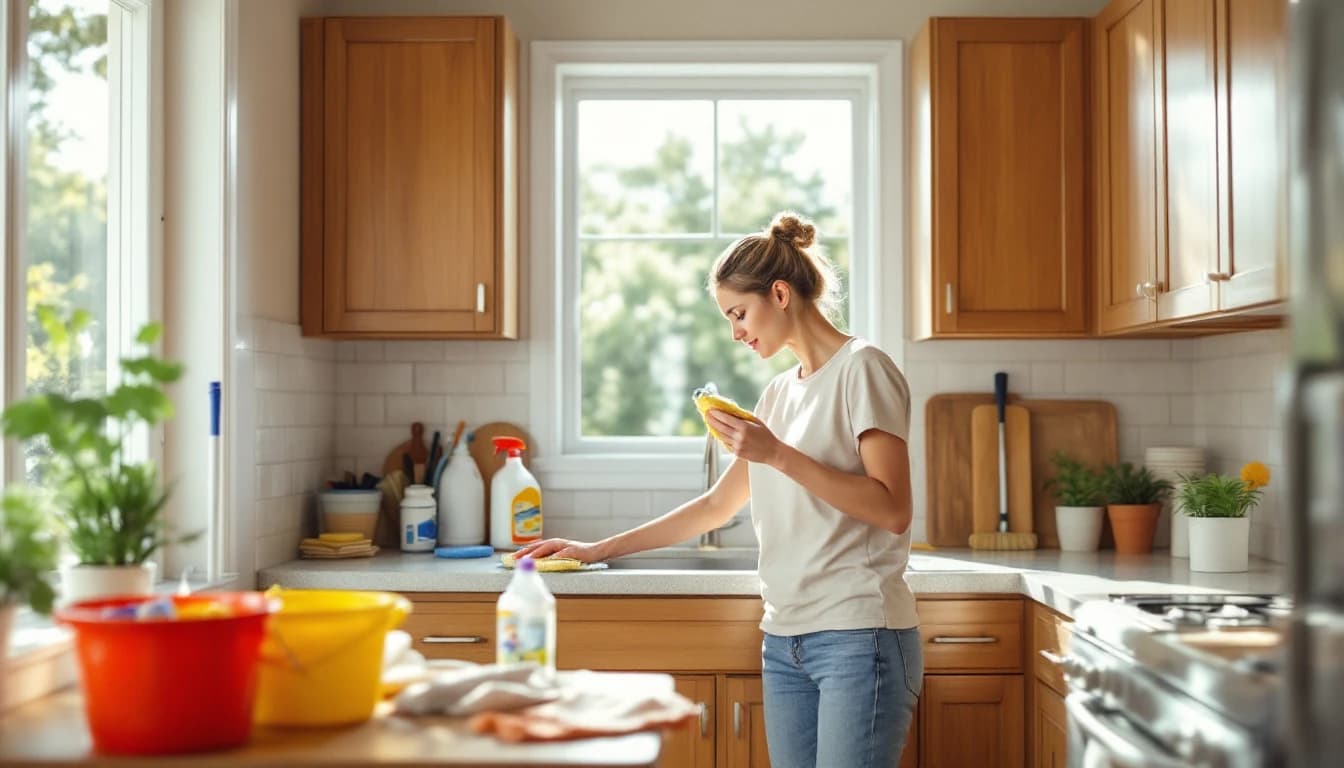
2026 honest comparison of professional house cleaning and DIY in DFW: supply and equipment costs, realistic time accounting, where each genuinely wins
This is a fair question and it deserves a fair answer, including from a company that sells cleaning. Plenty of people should not hire a cleaning service. Plenty of people should have hired one years ago. The difference comes down to arithmetic most households never actually do, because the cost of doing it yourself is spread across a hundred small purchases and a lot of Saturday mornings that never appear on a statement.
As of July 2026, professional standard house cleaning in DFW is a flat $120 to $250 per visit, and a deep clean is $200 to $450. Those are published numbers. What follows is an honest attempt to put the DIY side on the same footing so you can compare something to something, instead of comparing a real invoice to a vague feeling that cleaning your own house is free.
The short answer
If you live in a small apartment, have time on the weekend, and do not mind the work, DIY almost certainly wins on pure economics. If you have a large home, two working adults, kids, pets, or a physical limitation that makes floor and bathroom work genuinely hard, professional service usually wins once you count your hours honestly — and it wins by a wider margin than most people expect, because the tasks DIYers skip are the expensive ones.
Most households land somewhere in between, and the best answer for them is not either/or. It is the hybrid model, covered further down.
What DIY actually costs in supplies and equipment
Start with the part you can put a number on. A household that cleans its own home properly is buying, on an ongoing basis:
Consumables, replaced continuously. All-purpose, bathroom, glass, floor, and toilet cleaner, disinfectant, degreaser, any wood or stone-specific product, paper towels, sponges, scrub pads, microfiber cloths, mop pads, trash liners, and vacuum bags or filters. Individually, none of it is expensive. Bought monthly for a year, it is a real line item — and it is the kind of spending that never gets tallied because it hides inside grocery runs.
Durable equipment, replaced every few years. A vacuum good enough to actually pull soil out of carpet rather than push it around. A mop system with washable pads. A steam cleaner if you have tile, or a carpet spot machine if you have pets. An extendable duster, and a ladder if you have the vaulted ceilings common in DFW homes built after 1995. A decent vacuum alone is a meaningful purchase, and the cheap ones get replaced often enough that buying cheap costs more over five years.
The hidden replacement cost. The wrong product on the wrong surface is expensive: an acidic cleaner that etches natural stone, an alkaline product that strips the finish on luxury vinyl plank, bleach on colored grout, an abrasive pad on a glass cooktop. A single mistake here can cost more than a year of professional service. If you are choosing products yourself, our guide to eco-friendly cleaning products for DFW homes covers what works and what to keep away from which surfaces.
None of this makes DIY a bad choice. It just means the honest comparison is not "$150 versus zero."
The time side, counted honestly
There is no survey to cite here and we are not going to invent one. What we can do is reason from the work itself, for a typical three-bedroom, two-bathroom DFW home of roughly 1,800 to 2,200 square feet.
A thorough whole-home standard clean — kitchen counters, sink, stovetop and appliance exteriors, both bathrooms scrubbed and sanitized, all surfaces dusted at reach height, mirrors and glass, every floor vacuumed and mopped, trash out, beds made — is a multi-hour job for one person working steadily without interruption. Anyone who has done all of it in one sitting knows it consumes most of a morning, and that is with everything already put away before you start.
A deep clean — the same list plus baseboards, door frames, window sills, hand-wiped blinds, cabinet fronts, inside the microwave, behind visible appliance edges, grout, and hard-water scale on shower glass — is most of a day for one person, and realistically gets split across a weekend because nobody sustains that pace. A professional crew does it faster because several people work in parallel with commercial equipment and a fixed sequence, not because they cut corners.
That is the entire time argument, and you can price your own hours however you like. The point is not to tell you what your Saturday is worth. It is that "free" is not the right number for it.
Putting the two side by side
| Factor | DIY | Professional |
|---|---|---|
| Cash per standard clean | Supplies only, spread across the year | Flat $120–$250 |
| Cash per deep clean | Supplies plus any specialty product | Flat $200–$450 |
| Equipment cost | Vacuum, mop system, steam or spot cleaner, ladder | Included, never your expense |
| Time per standard clean | Most of a morning for one person | Zero of your hours |
| Time per deep clean | Most of a day, usually split over a weekend | Zero of your hours |
| Consistency | Depends on the week you are having | Same scope, same crew, every visit |
| Skipped tasks | Grout, hard water, high dust, baseboards | In scope on a deep clean |
| Surface-damage risk | Real, if products are chosen wrong | Carried by an insured company |
| Best for | Small spaces, tight budgets, people who like it | Large homes, dual-income, health limits, deadlines |
Where DIY genuinely wins
Small apartments and condos. A one-bedroom apartment does not take most of a morning; it takes an hour or two, and the professional value proposition thins out fast at that scale. If you live in 700 square feet with one bathroom, cleaning it yourself is usually the right call. Our comparison of condo and house cleaning differences covers where that line sits.
Genuinely tight budgets. If the choice is between a cleaning service and a bill, clean your own house. That is not a hard call, and anyone who tells you otherwise is selling.
People who like it. Some people find cleaning satisfying and restorative. That is a real benefit and it does not need to be justified economically.
Households already doing it well. If your grout is clean, your shower glass is clear, and nothing is quietly accumulating, the system is working. Do not fix it.
Where professional wins
Large homes. The math turns decisively past roughly 2,500 square feet, and it keeps turning. More floor, more glass, more bathrooms — and bathrooms are the labor-dense rooms. A five-bathroom house is a fundamentally different job than a two-bathroom house, and DIY effort scales with it while a flat professional rate stays inside a published band.
Two working adults. When the only available window is the weekend and the weekend is also when everything else has to happen, cleaning gets deferred, then deferred again, and the house drifts. It is not a discipline problem. It is a capacity problem.
Health, mobility, and allergy households. Bathroom and floor work is hard on knees, backs, and shoulders, and it gets harder with age or after an injury. For allergy sufferers there is a second issue: the act of dusting and vacuuming stirs up exactly what bothers you. The Environmental Protection Agency publishes general guidance on indoor air quality and routine dust removal in the home. If performing it triggers symptoms, having someone else perform it is not a luxury.
Pets. Shedding animals put a continuous load on carpet, upholstery, and baseboards that most DIY routines do not keep up with. Our pet-owner cleaning guide covers what that actually requires.
Deadlines. A move-out clean tied to a deposit ($200 to $500) or a listing photo shoot has a fixed date and a standard someone else is judging. Those are professional jobs.
The hybrid model, which is what most people should do
The framing of "DIY versus professional" is a false choice for the majority of households. The structure that works best in practice is this:
One professional deep clean to reset the baseline ($200 to $450). This gets the baseboards, blinds, grout, shower glass scale, window sills, and appliance detail back to zero — the accumulated work that DIY routines almost never reach.
DIY maintenance between visits. Wiping counters, dishes, quick bathroom passes, keeping floors picked up. This is the part that is genuinely fast when the house is already at baseline.
Professional standard visits at an interval that matches your life ($120 to $250 each). Monthly for a household that stays on top of things, biweekly for most, weekly for large homes with kids and pets.
A deep clean two to four times a year to reset the detail again.
This structure costs far less than weekly professional service and produces a much better result than DIY alone, because the tasks that require equipment, time, and technique get done properly on a schedule while the easy daily upkeep stays where it belongs — with you. Our recurring vs. one-time cleaning guide covers why maintenance visits price lower than repeated one-off cleans.
The tasks DIY skips, and why they cost money later
This is the strongest argument for periodic professional work, and it has nothing to do with how tidy your house looks.
Grout. Bathroom and kitchen grout absorbs soil, soap film, and moisture. Mopping the tile does not clean the grout — it just moves dirty water into the lines. Left long enough, grout darkens permanently and starts to fail, and regrouting a shower is dramatically more expensive than having it cleaned twice a year.
Hard water scale. This is North Texas's signature problem. Mineral deposits build on shower glass, chrome fixtures, and faucet aerators, and past a certain point the etching is permanent. Glass shower doors are the classic casualty: caught early, scale wipes off with the right product and technique. Left for two years, the glass is permanently clouded and the only fix is replacement. Our guide to deep cleaning hard-water homes goes deeper on what works.
High dust and HVAC-adjacent surfaces. Return-air vents, supply registers, ceiling fan blades, the tops of door frames, and light fixtures collect dust that then recirculates through the house every time the system runs. Almost nobody does this on a DIY schedule because it requires a ladder and it is not visible from standing height. It is one of the highest-value items on a deep-clean list.
Baseboards and door frames. Purely cosmetic, but it is the single most visible difference between a house that has been cleaned and a house that has been tidied. When people say a professionally cleaned home "looks different" and cannot say why, this is usually why.
Behind and under appliances. Grease and debris behind the range and under the refrigerator is a pest attractant and a genuine fire consideration. It is a twice-a-year job at most, but it needs to happen.
Our house cleaning checklist for DFW homeowners lays out what belongs on a routine and what belongs on a periodic schedule, and what is included in a deep clean covers the full detail scope.
Making the call
Ask yourself four questions honestly. How big is the house, and how many bathrooms? Under 1,500 square feet with one or two baths, DIY is very defensible; over 2,500 with three or more, the professional case gets strong. What is a Saturday morning worth to you right now? Not in the abstract — this month, with what is actually on your calendar. When did you last clean grout, shower glass scale, vents, and baseboards? If the honest answer is "I do not know," you already have deferred maintenance accruing. And is DIY actually happening? Not whether you intend to. Whether it is.
If the answers point toward hiring, you do not have to start with a weekly plan. Start with one deep clean, see the difference, and decide the rhythm afterward. If they point toward DIY, keep your products matched to your surfaces and put grout, hard water, and high dust on a calendar rather than a whim.
You can see our full flat-rate ranges and scope on the house cleaning service page and the deep cleaning page, or by area on our Fort Worth and Arlington hubs. For Fort Worth pricing specifically, our 2026 house cleaning cost guide has the full breakdown.
Frequently asked questions
Is a cleaning service actually worth it?
It depends on the size of your home and the value of your time. For a small apartment where a full clean takes an hour or two, DIY usually wins. For a home over about 2,500 square feet with three or more bathrooms, two working adults, or pets, professional service at a flat $120 to $250 per visit typically wins once you count your hours and the tasks DIY routines skip.
How much does DIY house cleaning really cost?
More than most people think, though less than professional service in cash terms. You are paying for consumables replaced continuously — cleaners, microfiber, mop pads, paper goods, vacuum filters — plus durable equipment like a good vacuum, a mop system, and possibly a steam or spot cleaner, replaced every few years. The largest hidden cost is using the wrong product on a surface, which can cost more to repair than a year of service.
Can I do a professional deep clean myself?
You can, but plan for it realistically. For a typical three-bedroom home, a full deep clean including baseboards, blinds, window sills, grout, hard-water scale, and appliance detail is most of a day for one person and usually gets split across a weekend. A professional deep clean at $200 to $450 is faster mainly because several people work in parallel with commercial equipment.
What is the hybrid approach to house cleaning?
Book one professional deep clean at $200 to $450 to reset the baseline, handle light daily upkeep yourself, then schedule professional standard visits at $120 to $250 on whatever interval fits your household. Add a deep clean two to four times a year to reset the detail work. It costs far less than weekly service and produces a much better result than DIY alone.
What do most DIY cleaners miss?
Grout, hard-water scale on shower glass and fixtures, high dust on vents and ceiling fans, baseboards and door frames, and behind and under appliances. All five are deferred-maintenance items rather than cosmetic ones — clouded shower glass and failing grout are expensive to fix and cheap to prevent, which is the strongest argument for a periodic deep clean at $200 to $450.
Does hiring a cleaner mean I stop cleaning entirely?
No, and the households happiest with recurring service do not. Dishes, counters, and picking up between visits stay with you, which is easy work once the home is at baseline. The professional visit handles bathrooms, floors, dusting, and the periodic detail work that takes equipment, time, and technique.
If you want a firm number before deciding, tell us your approximate square footage, bedroom and bathroom count, whether you have pets, and how long since the last professional clean. We will place you in the $120 to $250 standard range or the $200 to $450 deep-clean range on the phone in a couple of minutes — no in-home sales visit and no "call for pricing" runaround. Call (682) 201-2909, email info@lauramaidservices.com, or reach us directly at (682) 201-2909.